
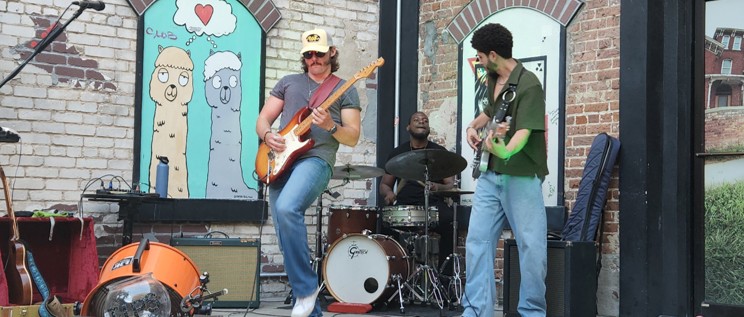
On any given night in Tampa Bay, George Pennington might be coaxing fire from an electric guitar, shaping a full-band arrangement with horns and keys, or pulling a room in close with a solo acoustic piece. For Pennington, every performance is a chance to make something that cannot be repeated — a one-night-only collision of craft, energy, and instinct.
When Pennington performs with his trio, he thinks in terms of the classic power-trio tradition: three musicians creating enough sound, movement, and energy to fill the room without overcrowding it. He points to the lineage of Cream, the Jimi Hendrix Experience, Motörhead, The Police, and Rush as examples of musicians who each carry a wide sonic responsibility within a tight ensemble.
For Pennington, that format brings out a fiery, active guitar style. It also gives his bandmates room to stretch. Depending on the gig, bassist Sebastian Siaka and drummers Rod Al Nord or Matt Salvador can push the music into a more open, explosive space where each player contributes heavily to the sound.
But Pennington is not limited to one setting. With his full band, George Pennington and the Odyssey, the arrangements can expand to horns, keys, and as many as seven players. That version of the music is less wild and more tied to the compositions themselves. As a solo artist, he shifts again, leaning into ballads, musical theater-inspired art songs, acoustic fingerstyle pieces, and classical guitar techniques.
Teaching came early for Pennington. The day after graduating high school, he began working at a summer camp at the same school, taking on light teaching responsibilities that grew over time. That path eventually connected with his studies at the University of South Florida, where he experienced a music education program that combined traditional training with a more progressive view of what young musicians could create.
USF gave him exposure to the familiar pillars of school music — choir, concert band, marching band, conducting, and choral direction — while also encouraging students to write songs, record themselves, and use modern technology.
Pennington recalls participating in an iPad band called Touch, where performers used digital devices in live settings to explore how technology could fit into music education.
That creative approach shaped how he thinks about musicianship. Instead of limiting players to what is printed on the page, Pennington values asking what else an instrument can do, how a player can contribute to a group, and how technology can open new possibilities without replacing the human element.
Pennington’s earliest musical memories are closely tied to family. One of the moments that stayed with him was hearing Stevie Ray Vaughan’s version of “Little Wing” while riding in the car with his father. The sound of that Stratocaster became a core memory and helped root his love of blues, rock, and power-trio energy.
His father, an opera singer, also exposed him to the power of the human voice. That influence widened Pennington’s musical world beyond guitar-driven rock into choir, musical theater, classical voice, and local blues jams. As a middle school and high school student, he was already playing in bands around town and absorbing different styles at the same time.
While he listens broadly and notices how modern bands use promotion, production, and sound design, Pennington describes himself as an old soul. He is still drawn to recordings that feel raw, tight, and alive — the kind of performances where the energy is impossible to smooth out or manufacture.
Asked about artificial intelligence and music, Pennington sees an opportunity for skilled instrumentalists to stand out. He hopes that AI will highlight the difference between a generated texture and a musician who has spent a lifetime actively discovering, exploring, and improvising on an instrument.
To him, the value of live music is in the details: the push and pull of a performance, tone variance, unpredictability, and the fact that every show is slightly different. He calls that “one of one” quality something he continues to chase, because he never wants to play a piece exactly the same way twice. “I think that’s the magic of live music,” Pennington says. “Every show is a one-of-a-kind thing.”
Pennington has released three albums, with the most recent still less than a year old. He also has tracks in progress for a future release, though he tends to think in terms of complete bodies of work rather than isolated singles. For him, a larger project can better capture a band’s range of ideas and the intention behind the music.
His performance résumé includes memorable opening slots, including a last-minute opportunity to open for the Gipsy Kings at Ruth Eckerd Hall before a sold-out audience of about 2,200 people. He performed a classical piece he wrote called “Glimpses of Spain,” experiencing the intensity of a seated crowd focused closely on his playing.
He has also opened for Selwyn Birchwood, a fellow Tampa Bay-area musician he describes as a friend and colleague. Those pairings have helped Pennington reach new listeners and reinforced the importance of finding artists whose music fits naturally together.
May 29 at Crowbar, is one of the found remembered shows, with the Ybor City venue preparing to close at the end of July, he describes the show as his “last dance” there and a celebration of both the venue’s legacy and the community it helped build. The lineup includes Vision Crystal, bringing bluegrass, folk rock, Americana, violin, and acoustic guitar textures; Light the Wire, with a mystical folk-rock sound and Fleetwood Mac-inspired harmonies; George Pennington and the Odyssey in full-band form with horns, keys, and guests; and the Cope Fam Jam, a final jam connected to the Crowbar community and the legacy of the Orange Blossom Jamboree.
When asked what he wants people to know about him, Pennington does not only talk about his own music. He talks about collaboration, autonomy, and the desire to help bring more Tampa artists together. As a musician, composer, arranger, and connector with studio experience around town, he wants to be part of projects that highlight different people and their talents.
Even as he continues to focus on his own identity as an artist, Pennington sees growth in widening the circle. He wants to bring more people into his musical orbit, contribute guitar ideas and arrangements to other artists’ work, and help facilitate creative projects across the local scene. That instinct may be the best summary of Pennington’s place in Tampa music: rooted in craft, driven by live energy, and still looking for new ways to make the scene larger than any one performer.
For show dates and more information, Pennington directs listeners to GeorgePenningtonMusic.com.